

Vanessa West, Chief of Staff
Vanessa (she/her) is a member of the Lheidli T’enneh First Nation and had served as an elected member of Council from 2001 to 2009 and from 2015-2019. She previously worked as the Treaty Office Manager for the Lheidli T’enneh Treaty Office for nine years from 1998-2007. Prior to taking on the role of Chief of Staff for the BC Assembly of First Nations, she worked with Positive Living North, an Aboriginal HIV/AIDS non-for-profit service organization, transitioning her career from First Nations politics to the social services field. Initially managing the street-level HIV/AIDS/HCV Prevention Program, the Fire Pit Cultural Drop-In Centre in 2007, she then moved into the role of Executive Director, which she held from 2008 to 2018.
To expand her knowledge and understanding around addictions and street- involved populations, she began working for the AIDS Prevention Program/Needle Exchange in Prince George from 2008 to 2013 as an after-hours Intake/Support Worker. During this time, Vanessa also volunteered as a Board Member for the Canadian AIDS Society and served two terms with this national organization.
Vanessa is the proud mother of three children, Jordan, Alexandria and John-Michael. She currently lives in her community with her partner of ten years, Randy, and joined the BCAFN team in April 2018.
Victoria Austin, Executive Assistant to Regional Chief
Victoria is Gitxsan (Paternal) and Wet’suwet’en (Maternal) from the Hagwilget Village Council with Matrilineal lineage to Stellat’en First Nation.
Victoria has lived in the central interior in the Lheidli T'enneh territory for 28 years and has been working with Indigenous Organizations for over 25 years. Victoria has had the privilege of working with great leaders in the Carrier Sekani Tribal Council/First Nations as well as other administrative positions with nations such as the Tsay Keh Dene, PGNAETA, GCFSS, CINHS and UNN. Victoria currently sits on the board of directors for the Aboriginal Housing Society of Prince George.
It has been a great pleasure to have worked with the BC First Nations for 8 years at the BCAFN and looks forward to what the future holds for her in this capacity.


Maureen Buchan, Senior Policy Director
An Anishinaabe from Bearskin Lake First Nation in Northern Ontario, Maureen has over 15 years of experience working for First Nations Political Organizations. She has a Master of Arts in Indigenous Governance from the University of Victoria as well as an Advanced Bachelor of Arts in Political Science and Government from the University of Manitoba
Maureen was formerly an Associate Faculty Member at the University of Victoria and has worked as a Policy Analyst and Specific Claims researcher for the Union of BC Indian Chiefs (UBCIC). She has been a Governor on the Law Foundation of BC since 2018 and sits as a Board Director on the Urban Native Youth Association. Maureen's other experience includes research work for various organizations including the Assembly of Manitoba Chiefs, Nicola Valley Institute of Technology, and Musqueum Nation.
As co-founder of Sparrow-Grant Consulting, Maureen has provided policy, political, and strategic advice for a number of BC First Nations. A proud mother of two, Maureen currently resides on Musqueam Territory.
Rayna Barter, Finance Manager
Rayna Barter is currently the Finance Manager for BC Assembly of First Nations. She lives and works on the unceded territory of the Lheidli T’enneh First Nation. She has worked in First Nations Finance, in varying capacities, since 1999.
Rayna has a Bachelor of Commerce from UNBC and holds the Certified Aboriginal Financial Manager (CAFM) Designation since 2015 and the Certified Aboriginal Professional Administrator (CAPA) Designation since 2019. Rayna has been a member of AFOA since 2006.
During her career Rayna has worked for Carrier Sekani Family Services (CSFS), Carrier Sekani Tribal Council (CSTC) and Burns Lake (T’sil Kaz Koh) Band prior to accepting her current position at BCAFN.
During her 10-year tenure at CSTC she spent over half of her time providing Finance Advisory Services to the 8 communities that make up CSTC. Her work in the communities allowed her to understand some of the struggles that many communities face. Not just around sub-par funding and overly onerous reporting, but with capacity development and retention of qualified employees.
Rayna’s passion is education, as she is a lifelong learner. She has spent many years volunteering in her community as a ringette coach and a learn to run leader. When not working, Rayna loves spending time with her family and friends, camping, running/weight lifting and being outdoors.


Annette Schroeter, Communications Officer
Annette (she/her) was born to Anishinaabe and German parents in Prince George, BC and is a member of the Muskrat Dam First Nation located in northwestern Ontario. Most recently she worked for the Carrier Sekani Tribal Council as the Communications Coordinator and has also worked with First Nations communities in northern Ontario in a liaison capacity. Annette has an MA degree in First Nations Studies and Bachelor’s Degree in History and Anthropology, both from the University of Northern British Columbia. She also holds a Bachelor’s of Design from Emily Carr University of Art & Design.
Patricia Rojas, Policy Analyst and Regional Climate Change Coordinator
Residing as a settler in the traditional Secwepemc territory of the T'exelc First Nation in the interior of BC, Patricia shares her life with her husband and two daughters. Before relocating to Canada from Peru in 2013, Patricia gained extensive international experience providing strategic and technical support to Indigenous Peoples on environmental impacts from resource development, water and watershed governance and sustainability policies for over 15 years. Patricia engaged in research, curriculum design and delivery, policy analysis, conflict resolution and negotiations, and advocacy pertaining to environmental and climate change issues. Her focus included safeguarding Indigenous rights, self-determination, sovereignty and promoting social and environmental justice. Patricia holds a Master’s Degree in Sustainability with a specialization in Policy Analysis from the Polytechnic University of Catalonia (Barcelona, Spain), a Master’s Degree in Social Management from the Pontifical Catholic University of Peru, and a Bachelor's Degree in Civil Engineering from the University of Cajamarca (Peru).


Sophia Iliopulos, Associate Director
For nearly a decade, Sophia has had the honour of working alongside First Nations, drawing on a multidisciplinary background grounded in Indigenous rights, governance, and policy. Since joining the team in 2020, Sophia has supported BCAFN’s advocacy efforts to uphold First Nations’ rights, title and interests across a diverse range of portfolio areas, with a primary focus on environmental policy. In her role as Associate Director, she provides strategic guidance, support and advice to BCAFN’s growing Environmental Sector as well as senior and political leadership to advance coordinated advocacy and policy solutions at the local, provincial and national levels. During her undergraduate studies, Sophia worked as a certified Waste and Wastewater Operator with the City of Prince George, gaining practical experience in community infrastructure and water systems. She holds an Honours double major in International Studies and Political Science from the University of Northern British Columbia, as well as a Master’s in Leadership from the University of Guelph. Sophia resides on the unceded and traditional territories of the Skwxwu7mesh (Squamish) Nation on the Sunshine Coast.
Sarah Behn, Economic Development Manager
Sarah is a band member of Fort Nelson First Nation and a community member of West Moberly First Nations, both located in Northeastern British Columbia. She has a Bachelor of Commerce in Entrepreneurial Management from Royal Roads University. Prior to joining the BCAFN, she worked as an independent consultant, focusing on grant writing and project management for First Nations in BC. She is passionate about economic equity and reconciliation within economic development.
As the Vice-President of the Canadian Geoparks Network, she continually works to elevate First Nations' priorities and voices in UNESCO designated spaces nationally and internationally. Sarah is a proud mother of two sons, residing within Treaty 8 Territories.


Aiden McGrath, Children & Families Policy Analyst
Aiden McGrath (he/him) comes from the traditional unceded territory of the Algonquin peoples, also known as Ottawa, Ontario. He is of mixed settler and First Nations ancestry, and is a descendant of Kebaowek First Nation.
Aiden holds an Honours Bachelor of Arts degree from Queen’s University, where he specialized in Political and Indigenous Studies
Aiden previously worked for Crown-Indigenous Relations and Northern Affairs Canada in the Settlement Agreement and Childhood Claims Branch, where he conducted research and policy work connected to the residential school system. He spent several years conducting research on the history of residential schools, specifically pertaining to school cemeteries and unmarked burial sites.
Aiden is deeply passionate about social justice and advocacy, and volunteered his time on various equity-based clubs during his time at Queen’s. Aiden was also one of the first members of the Arnprior Inclusivity and Diversity Advisory Committee in his hometown of Arnprior, ON.
Matthew Norris, Associate Director
Matthew Norris (he/him) is Nehithaw (Cree) and a proud member of the Lac La Ronge Indian Band in northern Saskatchewan (Treaty 6) and and lives on the unceded and traditional territories of the Musqueam, Squamish and Tsleil-waututh Nations. Matthew is President of the Urban Native Youth Association in Vancouver, BC and has nearly a decade of experience advocating for Indigenous rights across a wide-array of policy and governance areas, as a policy professional, community leader, and academic.
He is a PhD student in UBC's Department of Political Science’s International Relations Program with a focus on the implementation of the United Nations Declaration on the Rights of Indigenous Peoples, under the supervision of Dr. Sheryl Lightfoot. He is a graduate of the Masters program in UBC's Political Science Program with a focus on Deliberative Democracy, Climate Justice and Decolonization. Matthew has been highly active in the Indigenous community on campus; being the founding president of the First Nations Studies Student Association, an organizational member for the 2012 Global Indigenous Conference, and a graduate with a double Major from UBC's department of Political Science and First Nations Studies undergraduate programs.
Matthew has been previously employed by the City of Vancouver as a Policy and Communications Advisor to City Councillor Christine Boyle, where he has advised, researched and wrote City Council motions on housing policy, anti-racism, the implementation of Indigenous rights frameworks (UNDRIP), and heritage protection policy. He has been previously employed by the Union of BC Indian Chiefs and worked with the First Nations Leadership Council advising on a wide-array of provincial and federal policy and its impacts on Indigneous Nations.
Matthew actively writes and presents on issues and policies impacting Indigenous peoples, including in the Tyee, and the IWGIA's annual publication, The Indigenous World, podcasts, radio and community events.
Matthew has previously been an Indigenous Delegate to the United Nations Permanent Forum on Indigenous Issues, ran unsuccessfully for Vancouver City Council in 2022, and continues to volunteer his time in a variety of capacities including as President of the Urban Native Youth Association, Director on the Board of the BC Office of the Canadian Centre for Policy Alternatives, Member of UBC's Indigenous Strategic Plan Executive Advisory Committee, Co-Chair of the Vancouver Just Recovery Coalition and Member of the Indigenous Climate Adaptation Working Group for BC Climate Action Secretariat.


Kristi Denby, Environment Policy Analyst
Kristi (she/her) is a researcher and sustainability professional whose diverse career has led her to work on water and land reform policy research in South Africa, sustainable and regenerative tourism training and development across Canada, environmental assessments with a focus on Indigenous community impacts in Northeast BC and Alberta, and sustainable value chain projects in the high Amazon region of Peru. In her, over a decade of experience, she has incorporated a climate change, gender and social justice lens in her work and has had the privilege to learn from and work side by side with Indigenous Peoples in Peru, Tanzania, South Africa and Canada.
Kristi holds an interdisciplinary Master’s of Science in International Development Studies from the Norwegian University of Life Sciences. While in Norway, she worked with an international consortium of researchers focused on addressing historically rooted inequalities in water access through making water policies and practices more locally appropriate in Africa and beyond. Prior to joining BCAFN, Kristi’s work focused on sustainable tourism development and training where it became evident to her that the impacts of climate change and biodiversity loss were becoming a crisis in BC and around the world. Kristi is proud that her path has led her back to her home province of BC, where she now can weave her passion for reconciliation and social/climate justice issues into her work in incorporating First Nations value systems, knowledge and inherent rights into climate change and environmental policy.
Hannah Cripps, Economic Development Junior Policy Analyst
Hannah is of Nêhiyaw and Scottish ancestry and grew up in Treaty 6 territory. She holds an Honours Bachelor of Arts in Political Science from the University of Alberta, where her research focused on Indigenous identity law and politics within colonial systems. She will be attending the Peter A. Allard School of Law at the University of British Columbia to pursue a Juris Doctor, with the intention of practicing Indigenous business law.
Hannah joined BCAFN in February 2024 and continues to support policy and advocacy related to First Nations economic sovereignty, global trade, natural resources, food security, business development, and youth leadership.
Prior to joining BCAFN, Hannah worked as an Early Learning and Child Care Policy Analyst with the First Nations Education Steering Committee and held human resources roles with Crown-Indigenous Relations and Northern Affairs Canada and the Edmonton Mennonite Centre for Newcomers. She was also appointed to serve a two-year term on the Academic Appeals Committee at the University of Alberta. Across her work, Hannah is committed to advancing First Nations rights, supporting First Nations youth leadership, and strengthening pathways toward economic self-determination.

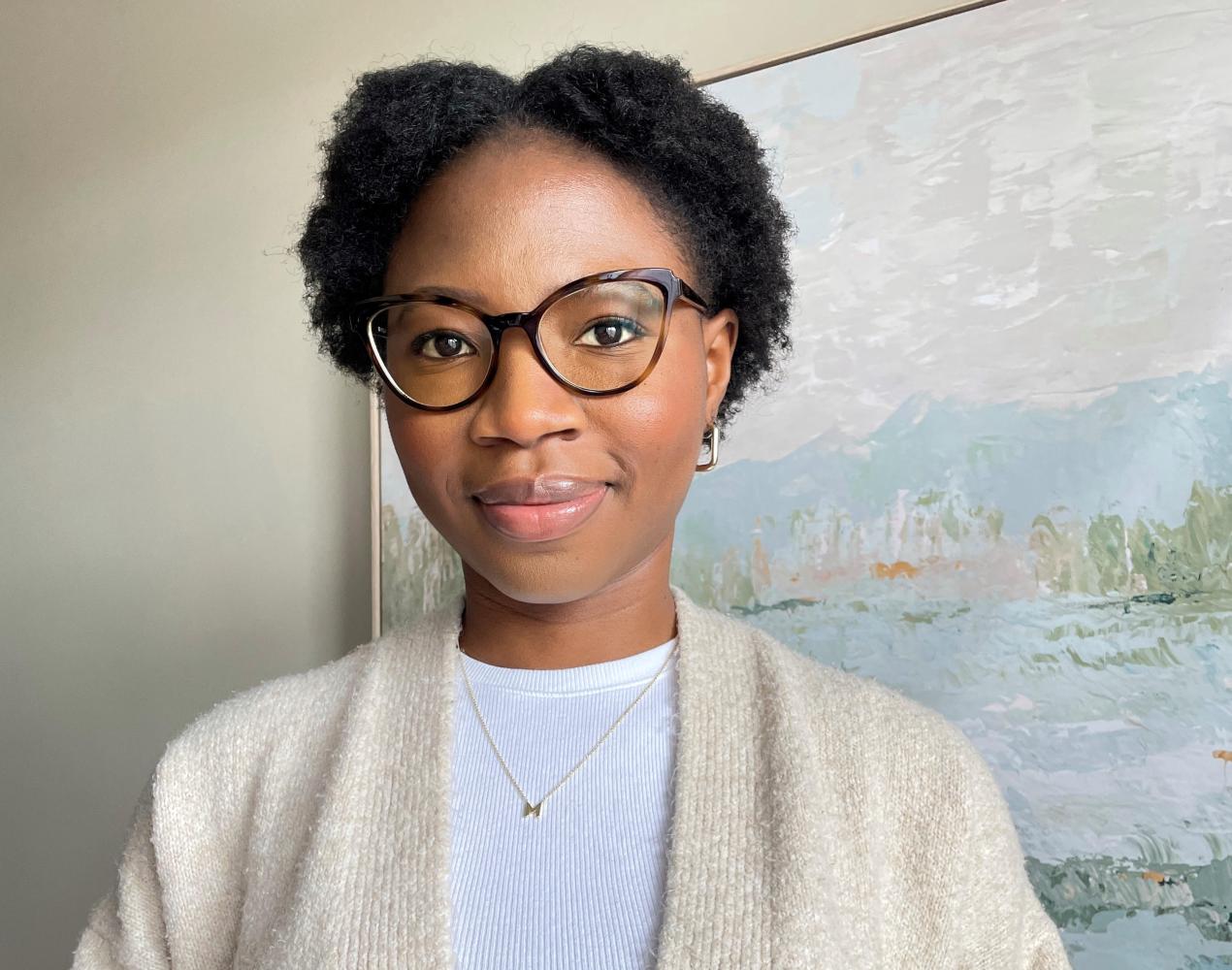
Mobi Atolagbe, Housing Policy Analyst
Mobi has extensive international experience in program management, business consulting, communications, and human resources. She holds a Master’s in International Development from the University of Northern British Columbia in Canada, and a Bachelor's in International Relations and Strategic Studies from Igbinedion University in Nigeria.
While studying for her Master’s degree, Mobi was opportuned to work at a local social services agency that supports individuals living on or close to the streets of Prince George. She became interested in the intersection of gender and homelessness and conducted research investigating women’s homelessness amid the COVID-19 pandemic. She is honoured to have her work selected for publication in a forthcoming e-book by the Canadian Observatory on Homelessness.
Mobi’s commitment to social justice and equity has led her to roles in community outreach, administering grant funding programs and ensuring the success of various community development initiatives. She is honored to contribute her skills and expertise to the BCAFN Housing portfolio, working towards the betterment of housing and infrastructure, and the overall well-being of First Nations communities.
Mobi grew up in Lagos, Nigeria and is of Yoruba heritage. For the past 5 years, she has been honored to live, learn, and work on the unceded traditional territories of the Lheidli T’enneh First Nation.
Nikki Saadat, Senior Economic Development Policy Analyst
Nikki holds a Masters in Forestry from the University of British Columbia and a Bachelor in Political Economy from Antioch College. Prior to working at the BCAFN, Nikki worked as a policy analyst at First Nations Emergency Services Society (FNESS), researching and developing policies aligned with principles from UNDRIP, the UN SDGs, and the BC Disaster Risk Reduction Action Plan. She developed policies for the Emergency Support Center and leadership training programs for chief and council to support governance and crisis management for rights and title holders.
During her Masters degree, her thesis discussed rural bioeconomy development in BC, focusing on wild kelp management in Haida Gwaii to strengthen the blue economy, coastal ecosystem, and keystone species by addressing issues of trophic cascade. Nikki also brings her experience as a researcher at the Qatalyst Research Foundation.
She is passionate about supporting First Nation communities in British Columbia and works at the intersection of policy, economics, and environmental stewardship. She is of Iranian descent and works within the traditional and unceded territories of the Musqueam, Squamish, and Tsleil-Waututh peoples.


Charlotte Bull, Jr. Climate Action Policy Analyst
Charlotte has a background in a variety of inter-disciplinary policy domains, including climate change, transportation, health, foreign policy and human rights. She holds a Masters’ in Public Policy & Global Affairs from the University of British Columbia and a Bachelor of Arts in Political Science & Geography with Honours from Trinity College Dublin, Ireland.
During her Masters, she had the opportunity to work with BCAFN as a UBC Sustainability Scholar, where she researched the barriers that First Nations communities face to access safe, affordable, and reliable low-carbon transportation. Through this work, she gained a deeper insight into the policies of exclusion that have barred many First Nations from accessing their mobility rights, which in turn impedes their access to many essential services. It was this experience that sparked her passion for developing equitable climate change policies that centre First Nations’ inherent rights, knowledge, and values.
Seeking greater knowledge of actionable climate policy, Charlotte participated in City Hive’s Youth Climate Innovation Lab and collaborated with the City of Vancouver on a project to encourage biking to school, which supported the School Active Travel Program. Building on her expertise, she was selected as a Policy Consultant for the Canadian Embassy in Hanoi, Vietnam, as part of her Master’s capstone project. There, she conducted research and fieldwork in the Mekong Delta, one of the world’s most vulnerable regions to sea level rise and environmental degradation. This research guided Canadian involvement in enhancing the security of the Mekong Delta.
Charlotte is excited to continue her work on climate and social justice issues for First Nation communities at BCAFN. She is grateful to be residing as a settler with English and German ancestry on the traditional, ancestral, and unceded territory of the Xʷməθkʷəy̓əm (Musqueam), Sḵwx̱wú7mesh (Squamish) and Səl̓ilwətaʔɬ/Sel̓ílwitulh (Tsleil-Waututh) peoples.
Alyna De Guzman, Jr. Climate Action Policy Analyst
Alyna De Guzman was born and raised in the Philippines. With gratitude, she presently lives on the traditional territories of the xʷməθkʷəy̓əm (Musqueam), Sḵwx̱wú7mesh (Squamish), and səlilwətaɬ (Tsleil-Waututh) peoples. She holds a Bachelors in Resource and Environmental Management with a focus on Planning from Simon Fraser University.
Alyna joined the BC Assembly of First Nations in 2021 as the Climate Change Intern with the support of the Pacific Institute for Climate Solutions. She contributed to the development of the BC First Nations Climate Strategy and Action Plan and wrote the monthly Climate Change and Water newsletters. In the following years, she joined BC Housing’s People, Plants, and Homes where she supported in providing therapeutic horticulture and food resources, initiatives, and workshops for community gardeners and members; and also Embark Sustainability Society where she coordinated and led food justice programs for university students.
Alyna has also taken her pursuits internationally. In 2024, she travelled to Tanzania for a Climate Resilient Food Systems and Sustainable Development Field School. There, she practiced permaculture-based approaches to climate change and worked with an Indigenous Maasai community to create photographic archives for their growing cultural centre.
Returning 3 years later after her first internship with the BC Assembly of First Nations, Alyna is thankful to be able to contribute her evergrowing skills and to be able to learn from and work with First Nations.


Aaron Wood-Lyons, Regional Nature Coordinator
Aaron supports nature conservation initiatives in collaboration with First Nations communities across British Columbia. With a background in environmental project management and Indigenous community engagement, Aaron brings experience in sustainable development, environmental consulting, and environmental stewardship. His work focuses on fostering partnerships and advancing nature conservation efforts that respect Indigenous knowledge and rights. Aaron holds a degree in Environmental and Resource Studies from Trent University and has a passion for protecting biodiversity and supporting Indigenous-led conservation efforts.
Ada Madam, Executive Assistant-Administration & Records Management
Ada Madam is a proud Wet'suwet'en woman from the Witset First Nation Band. She is most proud of her four children, which has significantly shaped her journey by learning and growing with them while caretaking of their grandmother.
At the Office Of the Wet'suwet'en, Ada brought the Urban Wet'suwet'en together with Cultural Activities and Advocated for Children and Families, while asserting our inherent rights under the guidance of Hereditary Chiefs. Previously, at PGNAETA, she worked for several years in various roles such as Customer Service Representative, to acting Executive Assistant. These roles have profoundly influenced her perspective on First Nations Strengths and Leadership, work ethics and respect for all walks of life. Reinforcing a commitment to continuous learning and adaptability.
The three things most important in Ada’s life are Healing, Learning, and Teaching those around her, guiding her decisions, shaping relationships, and defining her approach to both work and life.
Ada strives to walk in respect, believing that should be the guiding factor for all her interactions.


Laura Beaudry, In-House Legal Counsel
Laura is Cree and Métis, and a member of the Kapawe’no First Nation from Treaty 8 territory in Alberta. Laura left the rez to attend art college in Red Deer and moved to Vancouver 20 years ago, and proudly acknowledges and honours the unceded lands of xʷməθkʷəy̓əm, Sḵwx̱wú7mesh, and səl̓ilwətaɬ.
Laura graduated from the University of British Columbia’s Peter A. Allard School of Law with a Specialization in Aboriginal Law. During law school, she worked at the Association of Legal-Aid Lawyers, the Indigenous Community Legal Clinic, and the Bella Coola Legal Advocacy Program through Pro Bono Students Canada, while serving as President of the Indigenous Committee, Vice-President Academic of the Law Students’ Society and as the first Indigenous Councillor with the Alma Mater Society Council at UBC. Following graduation, Laura worked as a Policy Analyst at the Union of BC Indian Chiefs and articled at two full-service law firms focusing on Aboriginal Law before joining the BCAFN.
Laura has served on numerous committees and boards and has continually advocated for the rights of Indigenous peoples in both her career and personal life. Working for our people requires listening, learning, trust, and accountability, and Laura humbly follows the Cree principles of miyo-pimâtisiwin and tâpwêwin to fulfill those responsibilities and obligations.